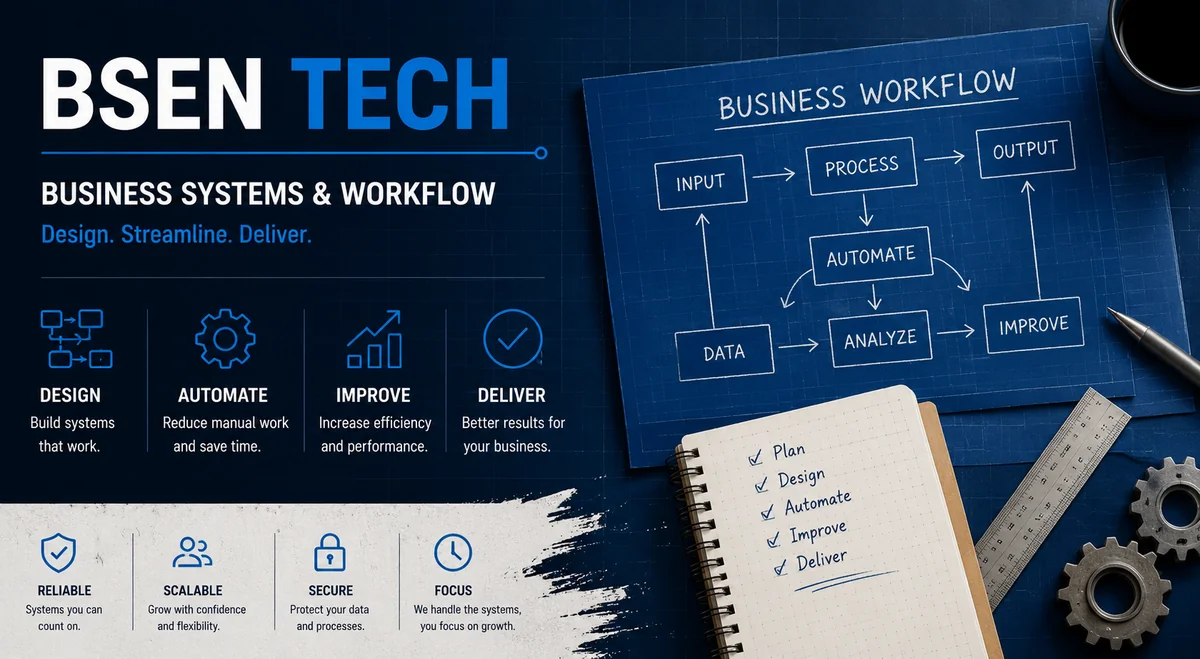
A workflow tool can simplify a small business process and still make the wider operation worse if it becomes another isolated place to copy data into. Integration therefore belongs near the start of tool selection, not on a technical checklist after the preferred product has already been chosen. The useful question is whether the workflow can move information and responsibility through the systems the business actually uses.
Draw the workflow across existing systems
Take one representative process and trace it from beginning to end. Identify where information originates, where people make decisions, which systems are updated and what downstream action depends on the result.
This exposes the integration points that matter. A tool may not need to connect with every application in the business; it needs dependable connections where manual transfer currently causes delay, duplication or uncertainty.
Identify the authoritative record for shared data
When a customer name, order status or project reference appears in several tools, decide which system owns that information. Integration should distribute or reference the authoritative value rather than create competing versions.
This matters particularly when users can edit the same field in more than one place. Without a clear ownership rule, synchronisation can spread bad data faster rather than improve consistency.
Distinguish native connections from workable integration
A marketplace listing or connector logo does not prove that the required business process is supported. Check what information can actually move, in which direction, under what trigger and with what limitations.
Where an API or another integration method is required, consider who will build and maintain the connection. The technical route matters less than whether the resulting workflow remains understandable and supportable.
Design for failure as well as successful transfer
Connections eventually encounter missing fields, unavailable services, changed permissions or unexpected records. Ask what users see when a transfer cannot complete and how failed work is recovered.
A robust workflow should not silently discard an important action. Exceptions need enough context for a person to diagnose the problem, correct it and continue without recreating the entire transaction.
Keep human approvals visible
Integration can move data automatically without making every business decision automatic. Where a person must approve a purchase, review a customer exception or confirm a change, preserve that decision point and record its outcome.
This creates a clearer division between system plumbing and business authority. The workflow tool should help the right person decide with the right information, then carry the approved result onward.
Check security and access across the whole path
Connecting systems can broaden access to information. Review which data the workflow tool needs, which credentials or service accounts are involved and what happens when a user's role changes.
A convenient integration should not depend on a former employee's personal login or grant broad access merely because configuration is easier. Ownership of integration access should be explicit.
Evaluate change, not just initial implementation
Small-business processes evolve. A new sales route, supplier or service may change the workflow. Consider how easily mappings, rules and connections can be understood and updated later.
Document the purpose of important integrations and the systems they depend on. This reduces the risk that an apparently minor change breaks a process nobody remembers is connected.
Choose the tool as part of an operating system
Servadra can help small businesses map workflows across existing applications, identify authoritative data and design integrations that preserve ownership and exception handling. That can be more valuable than selecting software in isolation because it starts with the business process the technology must support.
A good workflow tool does not merely automate steps inside itself. It becomes a dependable participant in the wider operation, moving information where it belongs while leaving people with clear visibility and control.