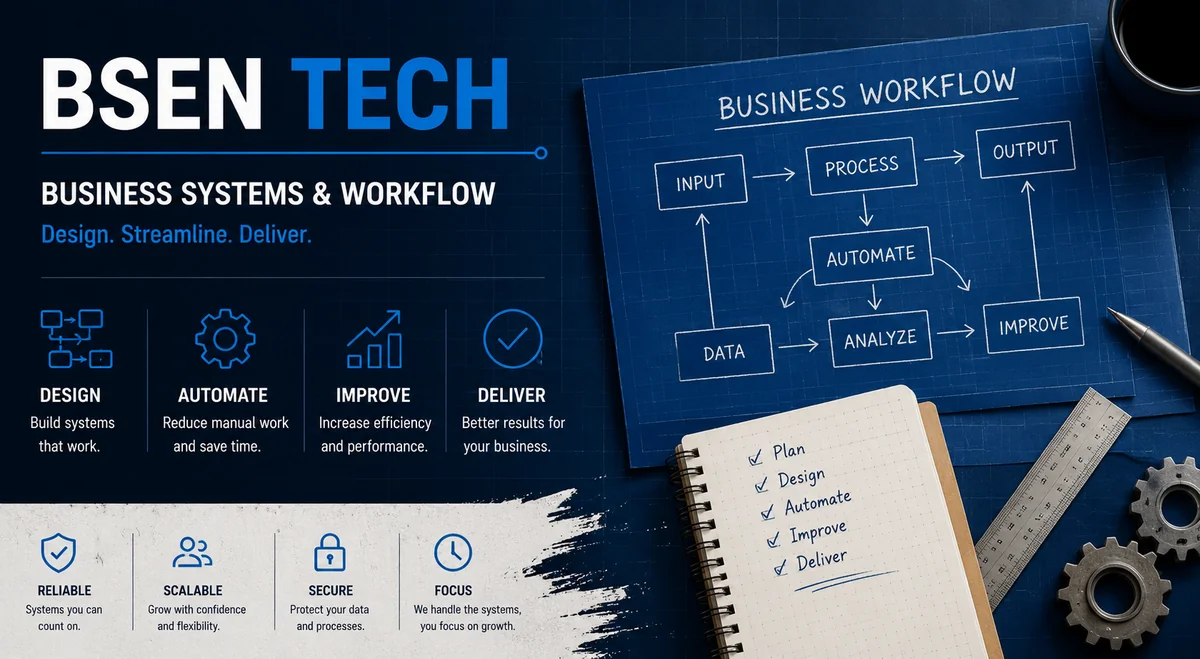
Automation can make a good small-business process faster, but it can also make a confused process fail more consistently. When teams automate around duplicated approvals, unclear ownership or unnecessary data entry, the technology preserves those weaknesses instead of removing them. Reviewing the process first gives the business a chance to decide what should happen before software begins making it happen automatically.
Start with the outcome, not the current steps
Describe what the process is meant to achieve for the customer and the business, then compare that outcome with the sequence people currently follow. This prevents an inherited routine from becoming the automation specification merely because it already exists. Some steps may have been created around a former system, team structure or problem that no longer applies.
Work backwards from a successful result. Ask what information must be available, which decisions genuinely matter and what evidence shows that the process is complete. This separates essential controls from administrative habits and gives the eventual automation a clear purpose beyond simply moving records more quickly.
Observe how the work really happens
Written procedures and actual behaviour can differ. Follow representative cases from beginning to end and note where people leave the main system, ask colleagues for help, re-enter information, wait for a decision or keep a private reminder because they do not trust the formal workflow.
Those workarounds are useful evidence. They may reveal a missing field, an impractical approval route or a hand-off that depends on knowledge held by one person. Automating the documented process without observing these realities can remove the flexibility that currently keeps the work functioning while leaving the underlying weakness untouched.
Clarify ownership at every hand-off
Automation depends on knowing who or what owns the next action. If responsibility is ambiguous in the manual process, an automated notification may simply send uncertainty more quickly. Define what event completes one person's responsibility, who receives the work next and what information must accompany the hand-off.
Also decide what happens when the normal owner is unavailable or the case does not fit the expected route. A workflow that assigns tasks perfectly under ideal conditions can still fail operationally if nobody owns exceptions. Clear responsibility should exist before software starts routing work at scale.
Remove steps that no longer earn their place
Ask why each approval, copy, status update or transfer exists. Keep controls that manage a real risk, support a decision or provide information somebody actually uses, but challenge activities maintained only through habit. Eliminating an unnecessary step is often simpler and more reliable than building automation to perform it.
This review can also expose duplicate controls. Two people may be checking the same information because an earlier problem led to an extra approval that was never removed. Automating both checks would make the duplication faster, not better. Simplification before configuration keeps the eventual workflow easier to understand, test and maintain.
Identify exceptions before designing rules
Routine cases may be straightforward to automate while unusual ones require judgement. Review examples that do not follow the normal route and decide which can be represented by clear rules and which should remain human decisions. The aim is not to eliminate variation simply because software prefers predictable inputs.
A useful automation design includes an exception route rather than pretending every case can be forced through the standard path. Define how an unusual item becomes visible, who reviews it and how it returns to the main process afterwards. Otherwise staff are likely to invent informal workarounds as soon as the first difficult case arrives.
Check the information the process depends on
A workflow cannot make dependable decisions from fields that are incomplete, inconsistent or interpreted differently by users. Identify the data required at each decision point, where it comes from and who is responsible for keeping it accurate. A field that looks suitable for an automated trigger may be unreliable because staff currently use it for several different meanings.
If people cannot reliably provide the information during the manual process, improve the data design before making it an automated dependency. Consider whether the value can be captured earlier, derived from a more dependable source or replaced with a clearer decision. Good automation rests on information the business can trust.
Choose automation where it removes friction
Strong candidates include predictable routing, reminders, record updates and other repeated actions with clear conditions and outcomes. Human judgement should remain visible where context, discretion or unusual risk matters. The objective is not the highest possible automation rate; it is a process that becomes easier to operate without losing appropriate control.
Start with a bounded part of the workflow where success can be observed. Define what should happen, test representative cases and check the effect on the people receiving the automated work. A smaller dependable automation is usually more valuable than a broad design that nobody can confidently explain when something goes wrong.
Review again after implementation
Once automation is live, compare the resulting workflow with the original business outcome. Look for new bottlenecks, unexpected exceptions and manual workarounds that users have created. If people repeatedly bypass an automated step, investigate the reason rather than assuming the answer is more enforcement.